Mostrando postagens com marcador História Antiga. Mostrar todas as postagens

[REPERCUSSÃO DE NOTÍCIA] Arco de Palmira que sobreviveu ao EI será replicado em Londres e NY

Réplicas de um monumento antigo em Palmira que aparentemente sobreviveu às tentativas de destruição do Estado Islâmico serão erigidas em Londres e Nova York.

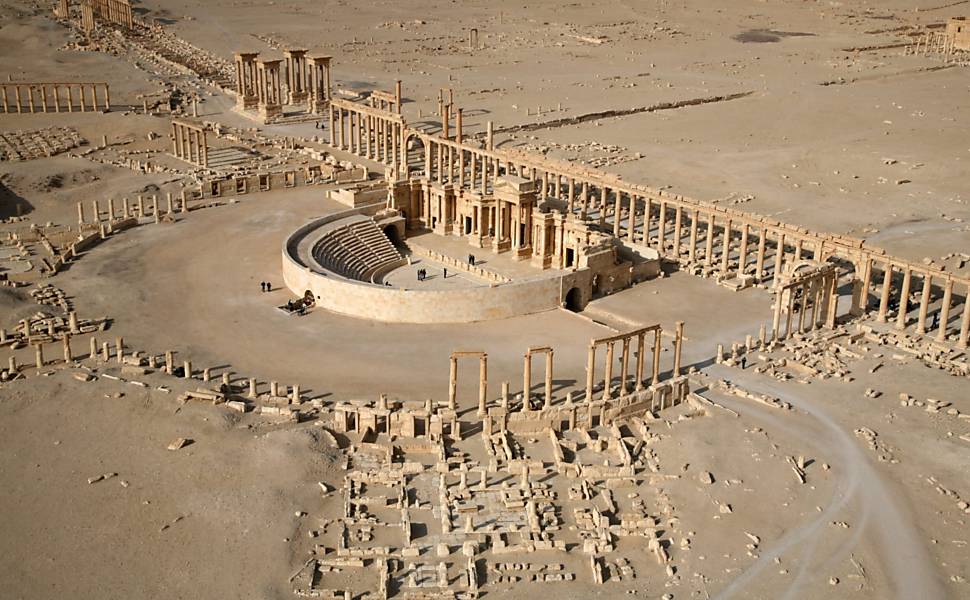
O arco de 15 metros de altura é uma das poucas partes que restam do templo de Bel, de 2.000 anos de idade, na cidade síria. Ele foi quase completamente destroçado pelos combatentes do EI quando destruíram Palmira sistematicamente, este ano.

A construção de uma réplica será a peça central de uma série de eventos relacionados à Semana do Patrimônio Mundial, prevista para abril, que tem como tema réplica e reconstrução. Também vem sendo descrita como um gesto de desafio contra tentativas de extremistas religiosos de apagar a história pré-islâmica do Oriente Médio.

Fundado em 32 d.C., o templo de Bel era consagrado ao antigo deus mesopotâmico Bel e formava o centro da vida religiosa em Palmira. Assim como aconteceu com muitos templos antigos, o local foi convertido em igreja cristã durante a era bizantina e depois em mesquita, quando os árabes levaram o Islã à região.

Conhecida como a Pérola do Deserto, Palmira —que significa cidade das palmas— encontra-se 210 km a nordeste de Damasco. Antes de o conflito sírio começar em 2011, mais de 150 mil turistas visitavam a cidade anualmente.

O templo de Bel era considerado uma das ruínas mais bem preservadas de Palmira, até a confirmação da sua destruição em agosto. No início do mesmo mês, o grupo decapitou Khaled al-Assad, um arqueólogo sírio de 82 anos que cuidava das ruínas de Palmira havia quatro décadas, e pendurou seu corpo em público.

DIGITALIZAÇÃO

Construir uma cópia do arco da entrada do templo foi uma proposta do Instituto de Arqueologia Digital (IDA, na sigla em inglês), uma iniciativa conjunta da Universidade Harvard, da Universidade de Oxford e do Museu do Futuro de Dubai, que promove o uso da imagem digital e da impressão 3D em arqueologia e conservação.

Em colaboração com a Unesco, o instituto no início deste ano começou a distribuir câmeras 3D para que fotógrafos voluntários fizessem imagens de objetos ameaçados em zonas de conflito em todo o Oriente Médio e norte da África.

As imagens devem ser armazenadas em um "banco de dados de milhões de imagens" que, espera-se, poderá ser usado para pesquisa, avaliação de patrimônio, programas educacionais e eventualmente, de réplicas em 3D —incluindo a reconstrução em escala natural.

A destruição do Templo de Bel aconteceu cedo demais para que o local fosse incluído no banco de dados do IDA, mas pesquisadores puderam criar aproximações 3D do local danificado através de milhares de fotografias bidimensionais.

Alexy Karenowska, diretora de tecnologia do IDA, disse que as representações seriam usadas para recriar o arco através de uma combinação de técnicas de impressão 3D controladas por computador. As peças serão feitas separadamente e depois montadas no lugar em que ficarão, em Trafalgar Square e Times Square.

Karenowska disse que o que se espera é que o projeto ajude a destacar a importância internacional do patrimônio cultural.

INFLUÊNCIA

O Templo de Bel é um tesouro arquitetônico do Oriente Médio, e sua influência na arquitetura teve um grande impacto em estilos clássicos espalhados por toda a Europa pelo Império Romano, que se estendeu para as margens do Eufrates, disse ela.

"Tendemos a pensar sobre herança cultural de forma um pouco provinciana", disse Karenowska.

"Pensamos também sobre o patrimônio cultural de outras pessoas como algo que é particularmente delas. Vemos muito isso com o Oriente Médio. As pessoas no Ocidente acham que é muito fácil dizer que o Oriente Médio tem esse grande patrimônio cultural e que esse problema [da sua destruição] é algo que está acontecendo com eles. A ideia é reforçar que o patrimônio cultural é algo compartilhado entre as pessoas. Trata-se das raízes das pessoas, e é importante reconhecer também que isso é algo que, como seres humanos, todos entendemos de forma profunda."

Roger Michel, diretor-executivo do IDA, disse ao Times: "É realmente uma declaração política, uma convocação a agir, para chamar a atenção para o que está acontecendo na Síria e no Iraque, e agora na Líbia. Estamos dizendo a eles que, se você destruir algo, podemos reconstruí-lo novamente. O valor simbólico desses lugares é enorme, estamos restaurando a dignidade para as pessoas."

Uma vez que já foram alvo de fanáticos em sua terra natal, Karenowska está de acordo com que a construção dos arcos pode representar um risco de segurança, embora ela tenha minimizado esse impacto. "Um edifício como a National Gallery ou Trafalgar Square, esses são os principais alvos em virtude do que eles são", disse ela.

"O nível de risco que se acrescenta é muito limitado, simplesmente pelo fato de colocar uma obra de arte instigante em um desses espaços. Isso é algo em que estamos pensando com muito cuidado e em que as pessoas envolvidas pensam diariamente."

REPORTAGEM: Islam's Origins: Where Mystery Meets History

The same spotlight of historical enquiry that scholars have long been shedding on the biblical past is now starting to illumine the origins of Islam, as Tom Holland explains.

Midway through the eighth century a monk living in the monastery of Beth Hale in Iraq recorded the arrival there of an eminent visitor. A ‘Son of Ishmael’ – one of the Arab dignitaries who served at the court of the caliph – had fallen ill. Naturally enough, since Christian holy men were renowned for effecting miracle cures, he had turned to the monks to help him with his convalescence. The Arab stayed ten days in the monastery and in that time he and his hosts argued freely about their respective religions. The monk, of course, portrayed himself as emphatically the winner. Nevertheless it is clear that the Arab had managed to land the odd blow. ‘Is not our faith better than any faith that is on the earth?’ he had demanded to know. ‘And is this not the sign that God loves us and is pleased with our faith – namely, that he has given us dominion over all religions and all peoples?’

The terms of this argument, it is true, were hardly original to Islam. Back in the early fourth century Eusebius, a Palestinian bishop, had written a biography of Constantine (r. 306-37), the emperor who had stunned the Roman world by converting to Christianity. God had blessed him for bowing his head before Christ with any number of rewards. Eusebius, who combined the talents of a polemicist with a profound streak of hero-worship, had sheltered no doubts on that score: ‘So dear was Constantine to God, and so blessed, so pious and so fortunate in all he undertook that with the greatest facility he obtained authority over more nations than any who had preceded him – and yet retained his power, undisturbed, to the very close of his life.’

This core equation – that worldly greatness was bestowed by God upon those who pleased Him – was one that reached back to the origins of human belief in the supernatural. Rarely had a society existed that did not see itself as somehow blessed by divine approval. Empires had invariably cast themselves as the favourites of the gods. So it was, some 300 years before Constantine, that Virgil had defined the Romans as a people entrusted by the heavens with a sacred charge: to spare the vanquished and to overthrow the haughty. A potent sentiment and an enduring one. Muslims as well as Christians had proven to be its heirs. The Qu’ran, composed though it was on the margins of the Roman world during the seventh century, bore witness to a conception of imperial mission that was not so different from the pretensions of Virgil’s day: ‘When you encounter the unbelievers, blows to necks it shall be until, once you have routed them, you are to tighten their fetters.’ So Muhammad, serving as the mouthpiece of God, had informed his followers. ‘Thereafter, it is either gracious bestowal of freedom or holding them to ransom, until war has laid down its burdens.’

The baptism of Christ depicted in 'The Chronology of Ancient Nations' by Al-Biruni, Islamic school, 14th century.

Yet by the time of Muhammad (570-632) much had changed from the heyday of the pagan empire and to seismic effect. The revolutionary notion that the universe was governed by a single, all-powerful god had decisively transformed people’s understanding of what the sanction of the heavens might mean. Just as Constantine had discovered in Christ an infinitely more potent patron than Apollo or Sol Invictus had ever been, so those who turned to the pages of the Qu’ran found revealed there a celestial monarch of such limitless and terrifying power that there could certainly be no question of portraying Him – as the Christians did with their god – in human form. Nothing, literally nothing, was beyond Him. ‘If He wishes, O mankind, He can make you disappear and bring others in your stead.’ To a deity capable of such a prodigious feat of annihilation what was the overthrow of an empire or two? Remarkable though it was that the previously despised and marginal Arabs had managed to trample down both Roman and Persian power, no explanation was needed for this, so Muslims came to believe, that did not derive from an even more awesome and heart-stopping miracle: the revelation to the Prophet of the Qu’ran. What surprise that a fire lit far beyond the reach of the ancient superpowers should have spread to illuminate the entire world when that fire was the Word of God?

***

So it was, across a vast sweep of Eurasia, stretching from the Atlantic coast to the frontiers of China, that a distinctive understanding of history came to be taken for granted. Whether in Christendom or in the House of Islam, the past was understood as the tracing of patterns upon the centuries by the forefinger of God. The divine had intruded into the sweep of earthly events and everything had changed as a result. The very fabric of time had been rent. Quite how a deity who transcended eternity and space might actually have descended from heaven to earth was, of course, a tricky problem for Christians and Muslims alike to solve and it took bitter and occasionally murderous argument to arrive at anything like a consensus. Only centuries after the birth of Christ did Christians come definitively to accept that their saviour had been both perfect man and perfect God; only centuries after the emigration of Muhammad from Mecca did Muslims come definitively to accept that the Qu’ran was eternal, not created. Such wrangling had been inevitable. Fathoming the purposes of an omnipotent and omniscient deity was no simple matter. As a ninth-century Muslim scholar, in a tone of awed defeatism, confessed: ‘Imagination does not reach Him, and thinking does not comprehend Him.’

Nevertheless, while Muslims and Christians had faced similar knots their respective attempts to unravel these had set them on radically different courses. The word, so it was claimed in St John’s gospel, had become flesh. The record of Christ’s life, for all that it lay at the heart of the Christian faith, was not itself considered divine, unlike Christ himself. Although Christians believed the Bible to be the word of God, they also knew that it had been mediated through fallible mortals. Not only were there four different accounts of Christ’s life in the Bible, but it contained a whole host of other books, written over a vast expanse of time, demanding to be sifted, compared and weighed against one other. As a result the contextualising of ancient texts came to be second nature to biblical scholars, and not just to believers.

By the 18th century the Church had ceased to hold the monopoly on subjecting its holy texts to scholarly enquiry. The model of history promoted by Eusebius, which traced in the past the working of the purposes of God, had started to become a thing of mockery. In his massive account of the decline and fall of the Roman Empire, Edward Gibbon subjected some of the most venerated compositions of late antiquity to a pathologist’s scalpel: ‘The only defect of these pleasing compositions is the want of truth and common sense.’ So he dismissed, with his customary solemn sneer, the biographical writings of St Jerome. Yet Gibbon’s tone of irony was to prove a mere presentiment of the far more naked scepticism that, from the 19th century onwards, would increasingly see almost every tenet of the Christian faith subjected to merciless dissection. The shock, to a still devout European public, was profound. When in 1863 a lapsed seminarian by the name of Ernest Renan presumed to publish a biography of Jesus that treated its subject not as a god but as a man like any other it was condemned in horrified terms by one critic as nothing less than a ‘new crucifixion of Our Lord’. The book, Life of Jesus, promptly became a runaway bestseller. Scandalous it may have been, but the European public was not averse to being scandalised.


Moses receives the law of God on Mount Sinai, an illustration from the Moutier-Grandval Bible, Tours, ninth century.

Time would demonstrate that there was to be no going back, in the Christian West, on the habit of subjecting to scientific enquiry what had for millennia been regarded as the sacrosanct word of God. Throughout the 19th century, in the hushed and sombre libraries of German theology departments, scholars would crawl over the pages of the Bible, gnawing away at the sacred text like termites. The Pentateuch, they demonstrated, far from having been written by Moses, as had traditionally been taught, seemed instead to have been stitched together from multiple sources. Not only that, but these same sources had almost certainly been written centuries after the events that they purported to describe. Moses, it appeared, had been made into a mouthpiece for laws that he might very well never have pronounced – if he had even existed in the first place. Here was an unravelling of the scriptural tapestry so devastating that even some scholars themselves began to fret over the implications: ‘It is to suspend the beginnings of Hebrew history,’ as one German theologian noted grimly, ‘not upon the grand creations of Moses, but upon airy nothings.’

Yet the achievements of biblical scholarship, nihilistic though they seemed to many, remained recognisably bred of the marrow of Christian culture. Debate about the authorship of the Pentateuch, after all, reached back at least to the time of Origen, the third century Alexandrian scholar. The methodology that historians in the West nowadays bring to bear on ancient sources owes far more to the traditions of Christian textual analysis than it does to Herodotus or Thucydides. Historicism, like so many intellectual off-shoots of the Enlightenment, is perhaps best considered as a bastard child of Christianity that then set about devouring its parent. Not that it has confined itself to questioning the verities of its own ancestral faith. Other religions, too, and the stories told to explain their origins have likewise been put under its microscope. Sensitivities here, however, are much more raw. If the scepticism of the West can often seem bleak even to those raised in its own traditions, then it can seem downright ravening to others. Offensive though modes of scholarship honed on the Bible may be to Jews or Christians, they can be vastly more so to people from a different religious background. And especially so to Muslims.

The explanation for this lies in the awe, exceptional even by the standards of other faiths, with which Muslims have always regarded their founding scripture. The nearest analogy in Islam to the role played by Jesus in Christianity is not Muhammad but the Qu’ran. Not merely the word of God, it is itself divine. That being so, its text must inevitably defy all attempts at rational analysis. Even to contemplate such a project is blasphemy. Devout Muslims are no more likely to question the origins of the Qu’ran than devout Christians are to start ransacking Jerusalem for the skeleton of a man with holes in his hands and feet. To treat it like any other text from antiquity, something to be prodded and taken to pieces and explained by the historical context in which it appeared, is to dabble one’s fingers in the very stuff of other people’s souls. Revelation, so it was said, had come upon Muhammad ‘like the ringing of a bell’ and had brought sweat to drip from his forehead. All who then heard him repeat what he had heard knew themselves to be in the authentic presence of the divine. The proof of that lay in the fact that those who had listened to him went on to dismember the two greatest empires in the world. ‘We went to meet them with small abilities and weak forces, and God made us triumph, and gave us possession of their territories.’ Such was what it had meant for the eternal to meet with the diurnal. The Qu’ran was a lightning strike from heaven, owing nothing to what had gone before.

A folio from a Qu'ran of gold leaf, silver and ink on indigo-coloured parchment. Probably Tunisian, c. 10th century

It is here, in any interpretation of Islam as a divinely-sponsored bolt from the blue, that history must needs meet and merge with faith. Almost 14 centuries on from the lifetime of Muhammad, the conviction that he was truly a prophet of God continues to move and inspire millions upon millions of people around the globe. As a solution to the mystery of what might actually have taken place in the early seventh century Near East, however, it is unlikely to strike those historians raised in the traditions of secular scholarship as entirely satisfactory. By explaining everything, it runs the risk of explaining nothing much at all. Nevertheless it is a measure of how potently an aura of the supernatural has always clung to the Qu’ran and to the story of its genesis that historians have found it so difficult to rationalise its origins. Mecca, so the biographies of the Prophet teach us, was a pagan city, devoid of any Jewish or Christian presence, situated in the midst of a vast, untenanted desert: how else, then, are we to account for the sudden appearance there of a fully fledged monotheism, complete with references to Abraham, Moses and Jesus, if not as an authentic miracle?

In a sense, the entire history of secular enquiry into the origins of Islam has been an attempt to arrive at a plausible answer to this question. Muslims, understandably sensitive to any hint that their prophet might have been a plagiarist, have always tended to resent the inevitable implications of such a project. And yet, if God is discounted as an informant, it is surely not unreasonable to wonder just how it came to be that so many characters from the Bible feature in the Qu’ran. Perhaps, it has been suggested, Muhammad absorbed Jewish and Christian influences during his business trips to Syria. Or perhaps, despite what the Muslim sources tell us, there were thriving colonies of Jews, or Christians, or both, in Mecca. Or perhaps the Meccan economy was afflicted by a crisis of capitalism, one that saw successful merchants and financiers growing ever richer, even as those on the breadline were left, in the historian Karen’s Armstrong’s words, ‘searching for a new spiritual and political solution to the malaise and disquiet in the city’ and finding it, somehow, in some unspecified manner, in the spirit of the age.

Yet all these explanations run up against an awkward stumbling block. Back in the 19th century, Ernest Renan – a brilliant Arabist when not putting the cat among Christian pigeons – had contrasted the presumed excellence of the sources for the life of Muhammad with the murk surrounding the founders of other faiths. ‘Islam,’ he declared, ‘was born, not amid the mystery which cradles the origins of other religions, but rather in the full light of history.’ Over the past 40 years, however, this proposition has come under brutal and escalating attack – so much so, indeed, that Islam’s birth, to an increasing number of scholars, now appears shrouded in an almost impenetrable darkness. Although the fact that Muhammad existed is generally accepted by specialists, one Christian source, written just two years after the traditional date of his death, describes a ‘false prophet’ leading the Arabs in an invasion of Palestine, while another, six years later, refers to him by name. Yet the allusions in scattered Christian sources of the seventh century to an enigmatic figure whom they describe variously as ‘the general’, ‘the instructor’, or ‘the king’ of the Arabs merely serves to highlight an astounding lacuna: the complete lack of reference to Muhammad in any early Muslim records. Only in the 690s did a caliph finally get around to inscribing his name on a public monument; only decades after that did the first tentative references to him start to appear in private inscriptions; and only around 800 did biographies finally come to be written of him that Muslims took care to preserve. What might have happened to earlier versions of his life we cannot know for certain. One possibility is hinted at by Ibn Hisham, whose biography of Muhammad is the earliest one to have survived in the form in which we now have it. Much that previous generations had recorded of the Prophet, so this biographer commented sternly, was either bogus, or irrelevant, or sacrilegious. ‘Things which it is disgraceful to discuss; matters which would distress certain people; and such reports as I have been told are not to be accepted as trustworthy – all these things have I omitted.’

Here, then, is terra firma. What we can know with absolute confidence is that by the early ninth century the precise details of what Muhammad might have said and done some 200 years previously had come to provide, for vast numbers of people, a roadmap that they believed led straight to heaven. God had seized personal control of human events. The world had been set upon a novel course. To doubt this conviction was to risk hellfire. Given this perspective it is scarcely surprising that any ambition to write history or biography as we might understand it should have paled into nothingness compared with the infinitely more pressing obligation to trace in the pattern of the Prophet’s life the wishes and purposes of the almighty. That is why, in leaving the ninth century behind and venturing back into the heaving ocean of uncertainty and conjecture that is the early history of Islam, today’s historians can find it such a struggle to identify reliable charts. Adrift amid the shadowy vastness, what prospect of finding landfall?

A detail from a ninth-century Qu'ran, which belonged to Sultan Osman III (r. 1754-57), showing a view of Mecca

Of course, there is always the Qu’ran and yet the holy text itself, once stripped of all its cladding, all the elaborate scaffolding of commentaries built up around it with such labour and devotion from the ninth century onwards, can seem only to add to the voyager’s sense of being lost upon a darkling ocean. If it did not come from God, then what might its origins have been? Answers to this, over the past few decades, have become increasingly various – nor as yet, among western scholars, is there any sign of a consensus. ‘Qu’ranic studies, as a field of academic research, appears today to be in a state of disarray’: such is the frank admission of Fred Donner, Professor of Near Eastern History at Chicago and the doyen of early Islamic studies. ‘Those of us who study Islam’s origins’, he has confessed, ‘have to admit collectively that we simply do not know some very basic things about the Qu’ran – things so basic that the knowledge of them is usually taken for granted by scholars dealing with other texts.’ Its place of origin, its original form, its initial audience – all are mysteries. That being so, it is certainly no longer possible to presume that there is anything remotely self-evident about the birth of Islam. Forty years ago any querying what Muslim tradition taught about its own origins might have been dismissed as mere crankish troublemaking of a kind that no more merited a response from heavyweight experts than did, say, the attempt to ascribe Shakespeare’s plays to Francis Bacon or the Earl of Oxford. All that has changed. Indeed it is hard to think of any other field of history so currently riven by disagreement as is that of early Islam.

Fortunately, amid all the confusion and obscurity, of one thing at least we can be confident: Islam did not originate in a total vacuum. Of the world into which Muhammad was born, with its rival superpowers and its formidable array of monotheisms, we are most decidedly not ignorant. To compare the would-be universal dominions of Persia and Rome with the empire that the caliphate became, or to trace echoes of Jewish and Christian writings in the Qu’ran, is to recognise that Islam, far from spelling the end of what had gone before, seems in many ways to have been its culmination. ‘What is the reason that God has delivered you into our hands?’ So the convalescing ‘Son of Ishmael’ demanded of the monk of Beth Hale. The question was one that Christians in turn, in the centuries before Muhammad, had demanded of Jews and pagans. The story of how Islam came to define itself and to invent a model of the past that would sanction such a definition, is only part of a much broader story: one that is ultimately about how Jews, Christians and Muslims all came by their understanding of their respective religions. Whether any of them truly derived from the intervention within human history of a god is not for the historian to say. But look at the brilliance and inventiveness of the civilisations into which they were born and it is certainly possible to recognise in all of them the authentic stamp of mortal agency.

The vision of God to which both rabbis and bishops subscribed and that Muhammad’s followers inherited did not emerge from nowhere. The monotheisms that became state religions from the Atlantic to central Asia had ancient, unexpected, roots. To trace them is to cast a searchlight across the entire civilisation of antiquity.

Tom Holland is the author of In the Shadow of the Sword: The Battle for Global Empire and the End of the Ancient World (Little, Brown, 2012).

Fonte: History Today (05.12.2015)

REPORTAGEM: The Military Response to ISIS: a historical perspective


In the light of Parliament’s decision to approve military action in Syria, Rory Cox looks back to the classical and medieval world to ask: ‘What makes a just war?’


Thomas Hobbes' book on the Peloponnesian War
Thucydides, the ancient Greek historian of the Peloponnesian War (431-404 BC), described how, at one point in the generation-long conflict, Athens was divided about how to deal with the rebellious city of Mytilene. Many Athenians supported a harsh military response, while others, led by Diodotus, urged restraint: 

Haste and anger are … the two greatest obstacles to wise counsel … the question is not so much whether they are guilty as whether we are making the right decision for ourselves … For those who make wise decisions are more formidable to their enemies than those who rush madly into strong action. 

The fundamental point made by Diodotus is that violence, whatever its justification, is often an obstacle to long-term stability. As today’s political leaders weigh the case for war against Islamic State, they must also ask themselves what they seek: vengeance, justice, stability, or peace?

An understandable desire for vengeance and justice impels the case for an enhanced military response to ISIS. However, when considered in an historical context, the strategic wisdom and even the ‘justice’ of a military response are far from obvious. Airstrikes are extremely unlikely to lead to stability in the region or security at home and the claim to be acting in self-defence may be weaker than it appears at first sight.

The recent attacks on civilians in Paris were abhorrent and cowardly. Since November 13th, France has stepped-up airstrikes against ISIS, declared a three-month-long state of emergency at home and was pivotal in drafting UN Resolution 2249, which exhorts other nations to take ‘all necessary measures’ to combat ISIS, claiming that the group represents a ‘global and unprecedented threat to international peace and security’. As a direct result, David Cameron has persuaded Parliament to expand UK military operations against ISIS targets into Syria, which he claims is politically, legally, and ethically justifiable.

The justification of such a military response may appear straightforward. As outlined in Article 51 of the UN Charter – cited by the Prime Minister to defend the legality of British airstrikes – France and Britain possess the rights of self-defence and collective self-defence of allies. A violent act of terrorism, perpetrated on French soil against unarmed civilians, constitutes a clear casus belli, necessitating a military response to punish a gross injury and limit future threats.

This kind of reasoning is broadly consistent with the just war tradition that has dominated Western ethical and legal thought for at least 2,500 years. Philosophers, theologians and jurists have stressed that wars should only be waged if certain conditions are present. There must be a just cause and a legitimate public authority to declare war. Armed conflict must always be a last resort, motivated by a desire for justice and peace rather than vengeance or profit. Presently, attacks like those in Paris are viewed by Western countries as offensive acts of aggression, unprovoked and unjust. Consequently, military responses are justified as acts of self-defence.

Based on a short-term view of events, this reasoning is persuasive. However, from a broader chronological perspective, the ethics, as well as the wisdom, of military responses to terrorism are far less clear-cut. Only when considered in a historical context – say a decade or more – can we begin to comprehend how those gunmen in Paris could be convinced that they were acting in self-defence and in the cause of justice. We might look back to the events surrounding the invasion of Iraq in 2003 as a starting point.

Islamic extremism feeds off the conviction held by many in the Middle East and elsewhere that the West bears a burden of responsibility for the region’s ills. This has been particularly apparent in the aftermath of the Second Gulf War. While the US-led operations against Saddam Hussein’s regime were militarily successful, the lack of a coherent post bellum strategy for political and economic reconstruction proved catastrophic. Needless to say, extremist groups distort and manipulate the reality of this history, but there is no escaping the fact that Western governments have played their part in pursuing a range of ill-conceived policies that have done little to enhance the stability of the region. Direct and indirect military intervention has proven particularly destabilising and has been a major factor in creating the conditions in which ISIS has flourished. This realisation forces us to ponder whether a military response to the Paris attacks can so confidently be justified as self-defence. Seen in this light, airstrikes in Syria are not a self-defensive reaction to an unprovoked injury, but rather another escalation of a long-running conflict – a conflict in which military force was initiated by Western governments.

The blame for killing hundreds of innocent people lies squarely on the shoulders of the individuals who commit and organise such attacks. I deplore ISIS and their brutality. I grieve for the lives they have destroyed; I mourn for the shattered ruins of Palmyra. Nevertheless, while many people fighting for ISIS are undoubtedly ignorant and cruel, some will be intelligent and convinced of the justice of their cause. This is the heart of the matter. Justice is a matter of perspective. It was for this reason that, from the late Middle Ages onwards, the Western just war tradition increasingly recognised the absolute right of sovereign states to identify and defend their own interests. This process really began with the Italian jurist Raphaël Fulgosius at the turn of the 15th century, but it gained significant momentum with the writings on war produced by the theologians and canon lawyers of the School of Salamanca during the 16th century. The legal right of independent states to wage war was most fully expressed by the Dutch jurist Hugo Grotius in his highly influential treatise De Jure Belli et Pacis (On the Law of War and Peace, 1625). This voluminous work is now widely regarded as the foundational text of modern international law. The basic realisation was that in wars between independent political communities, with each side claiming just cause, self-defence and sufficient authority, it was almost impossible to identify on which side (if any) justice truly resided. Who cast the first stone? Who was the aggressor and who the victim? Instead, Grotius argued that a common law existed among nations that should govern war and peace: the ius gentium, or ‘law of nations’. A ‘just war’, therefore, was a public war waged by two legitimate authorities in accord with the rules of war (ius in bello) established by the law of nations. In the West’s conflict against Islamic extremism, both sides claim to be acting in the cause of ‘justice’ and ‘self-defence’ – essentially a matter of perspective – but Western governments go further in claiming that only they, as sovereign states, have the legal right to use force. Terrorists are categorised as “non-state actors”, and are consequently denied the legal rights of prisoners-of-war as stipulated by the Hague and Geneva Conventions.

Long-term conflicts are typically resolved by two means: outright military victory or political reconciliation. The first is historically rare and may be unattainable in the fight against Islamic extremism. The second is slow and frustrating and fails to meet neither our desire for revenge nor our expectations of justice. The strategic value of military intervention is doubtful. We know from experience in Afghanistan and Iraq that killing jihadists does not diminish the allure of jihad: quite the opposite. Airstrikes and the inevitable civilian deaths that follow will certainly further alienate and potentially radicalise those who were not hostile previously. The sterile term ‘collateral damage’ will be used to disguise these civilian casualties, but they will be no less tragic than the lives lost in Paris. There is no doubt that an enhanced military response in Syria will provide further fuel for ISIS propaganda and make a long-term diplomatic solution harder to achieve. At some point, one side must have the courage to end the cycle of violence. It is clear that this must ultimately come from Western governments; it will not come from ISIS.

To step outside of a long-term historical process is difficult. But attempting to view recent events within a broader historical context may provide a valuable strategic perspective and prevent myopic policy decisions. It is impossible to predict how long this particular conflict will endure. Unfortunately, with all parties currently inclined to act in ‘haste and anger’, it will probably be several decades yet. Haste, anger and strong action may satisfy our human desire for vengeance; they may even fulfil our concept of justice. But as Thucydides witnessed 2,500 years ago, such a course rarely fosters stability, let alone peace.

Rory Cox is Lecturer in Late Mediæval History and Associate Director of the Institute of Intellectual History at the University of St Andrews. @DrRoryCox

Fonte: History Today (07.12.2015)

REPORTAGEM: Is Nefertiti hiding in the Valley of Kings' secret chambers?

Hidden chambers adjoining King Tut's mausoleum promise exciting archaeological finds. What they conceal remains a mystery. Nicholas Reeves believes it's the mysterious queen Nefertiti - and others don't.

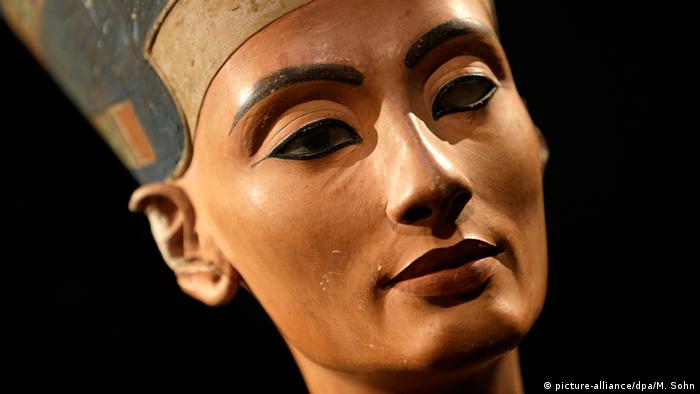
Neues Museum in Berlin - Büste der Nofretete
In a paper British Egyptologist Nicholas Reeves published last August , he claimed that Nefertiti's tomb may be hidden in rooms adjoining King Tut's burial chamber.
Now Egyptian antiquities minister Mamduh al-Damati has declared experts are "approximately 90 percent" sure that they will be finding "another chamber, another tomb, behind the burial chamber of King Tutankhamun." Al-Damati made the statement at a press conference on Saturday (28.11.2015).
What the chamber actually conceals is still a mystery, and gaining access to it will take months.
"I think it is Nefertiti, and all the evidence points in that direction," said Reeves. If he's right, it could turn out to be the greatest archeological discovery since Howard Carter, another British Egyptologist, found Tutankhamun's tomb in 1922.
Reeves maintains that the mysterious queen was the boy-king's mother and that she ruled over Egypt, succeeding her husband King Akhenaten, but these views are controversial. Click through the gallery above to discover why Nicholas Reeves believes Nefertiti is buried in a chamber right by Tutankhamun and why others prefer to remain more cautious - or even say that Reeves' claim is simply impossible.

Fonte: Deutsche Welle (30.11.2015)

REPORTAGEM: Digital Archaeology and Reconstruction

New publications and recent developments in the field.

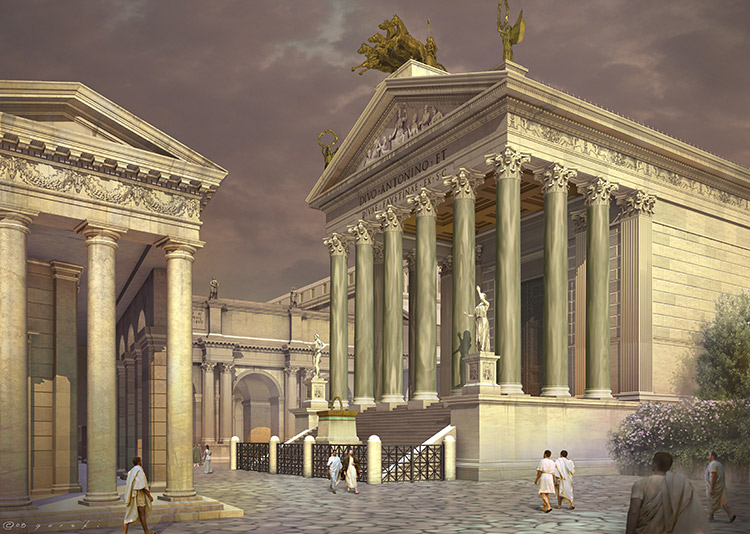
The Temple of Antoninus and Faustina
Archaeologists and historians are making increasing use of exciting developments in digital visualisation. A digital model of a site or building is a versatile tool, which can be easily edited and adapted to research, teaching, online and print publication, museum and documentary use.
Archaeologist James Packer and architect and illustrator Gil Gorski were early adopters of this technology, in the late 1990s, using it to create reconstructions of the Forum of Trajan in Rome. They have now turned to the Roman Forum itself. Their handsome new book, The Roman Forum: A Reconstruction and Architectural Guide (Cambridge), is grounded in the abundant archaeological and literary source material for this important area. It is an excellent example of how digital visualisation can enhance (and must draw on) more traditional scholarship.
The foundation of the book is a detailed reconstruction of the main Forum square and its surrounding buildings, set (mostly) just after AD 360. Images generated from the model illustrate a history of the Forum’s development and a topographically-organised architectural guide to each of its monuments, such as the Temple of Antoninus and Faustina (above). A concluding section considers the Forum in different eras, including questions of motion and sightlines.
The authors revel in the endless adaptability of their digital creation to illustrate their text. We see elevations, overhead views and plans, sections, colourful perspective views, watercolourish scenes evoking the École des Beaux-Arts and plenty of ‘entourage’ – dramatic lighting, human figures, snowfalls, sunsets and even, in the frontispiece, the authors themselves in Roman dress. More seriously, the potential for this sort of reconstruction to show alternative presentations is explored by, for instance, the Basilica Julia with and without a conjectural terrace at first-floor level, or different roofing solutions for the Temple of Vesta: there are also experiments with painted decoration (which the authors tend to avoid for lack of firm evidence).
The presentation is lavish, with full-page colour illustrations, diagrams, photographs and several fold-out panoramas and maps. This is a beautiful book, like Andrea Carandini’s recent Atlante di Roma Antica (Electa), and can be enjoyed as much for the quality of its pictures as for the clear presentation of the information on which they depend. As with Carandini’s work, there is scope for an online version, but this book is a landmark in the print possibilities of digital archaeological visualisation.
Digital archaeological techniques are also increasingly used to record ruins in vulnerable heritage sites. Recent outrages, including the barbaric murder in Palmyra of 82-year-old Head of Antiquities, Khaled al-Asaad, leave this and many other wonderful sites heavily damaged and inaccessible for the foreseeable future. A 3D digital record of such sites would at least mean that they were in some sense accessible to scholars and virtual ‘visitors’ around the world.
The Institute for Digital Archaeology (IDA), a joint venture between the universities of Harvard and Oxford, has launched an ambitious attempt to ‘crowdsource’ a Million Image Database of 3D images of threatened sites and objects. It has developed an inexpensive camera for field users – local museum affiliates, embedded military, NGO employees, and volunteers – to take and upload GPS-tagged 3D images, which will eventually reside in an open-source, Wikipedia-style online database.
The Million Image Database is a great example of a collaborative project harnessing technology to record imperiled sites. Imaginative individuals with the right skills can also make a difference: the Palmyra Photogrammetry project is the brainchild of one UK archaeologist, Conan Parsons, who is seeking photos of Palmyra to feed into photogrammetric software. With enough points of reference, this software can compare photos taken from different angles and locations to build up a ‘point cloud’, which can then be used to generate a navigable 3D model of the site, including buildings now destroyed.

Links for further exploration:
http://www.reading.ac.uk/classics/research/Virtual-Rome.aspx - Matthew Nicholls’ digital model of ancient Rome

http://digitalarchaeology.org.uk/projects/ - the website for the Institute for Digital Archaeology and its Million Image Database

https://www.facebook.com/Palmyra3Dmodel - crowdsourcing photogrammetry project that would welcome your photos of Palmyra.

http://www.byzantium1200.com
http://www.kadingirra.com/babylon.html
Digital reconstructions of the ancient cities of Byzantium and Babylon

http://www.digitales-forum-romanum.de - German digital reconstruction project, also looking at the Roman forum and reconstructing in in several different historical periods.

Matthew Nicholls is Associate Professor in Classics at the University of Reading.

Fonte: History Today (21.11.2015)

REPORTAGEM:: Agricultor desenterra 4 mil moedas romanas

Na Suíça, homem encontra um tesouro da Roma Antiga em seu pomar de cerejeiras: milhares de moedas de prata e bronze. Ao todo, elas pesam 15 quilos e estão em excelente estado de conservação.

Römische Münzen

Um produtor de frutas e legumes descobriu mais de 4 mil moedas romanas de prata e bronze enterradas em sua fazenda em Ueken, na Suíça. O tesouro de 1.700 anos remonta à Roma Antiga e pesa 15 quilos.
A descoberta foi feita em julho deste ano, quando o fazendeiro encontrou um pequeno monte de terra em seu pomar de cerejeiras, revelando muitas moedas cintilantes, anunciaram autoridades suíças nesta quinta-feira (19/11). Foram meses de discretas escavações até todo o conteúdo ser desenterrado.
Os arqueólogos disseram que as impressões das moedas estão legíveis, o que permitiu a um especialista determinar a sua origem na Roma Antiga, do imperador Aureliano (ano 270 a 275) ao imperador Maximiano (286 a 305).
"No pomar onde as moedas foram encontradas, nunca nada foi construído. É uma terra que sempre foi cultivada", disse o arqueólogo Georg Matter à agência de notícias AFP. Ele acrescentou que as moedas foram escondidas, provavelmente, logo após serem cunhadas.
O agricultor deve receber algum dinheiro pela descoberta, mas não poderá ficar com as moedas, muitas das quais têm um conteúdo de prata inusitadamente grande. Elas serão expostas num museu local.
Os arqueólogos acreditam que o valor original das moedas deve ter sido de pelo menos um ou dois anos de salários.
Alguns meses antes, os restos de um assentamento romano haviam sido descobertos durante uma escavação em Frick, uma cidade próxima.

Fonte: Deutsche Welle (20.11.2015)

REPORTAGEM: Arqueólogos encontram fortaleza bíblica em Jerusalém

Cidadela de Acra, construída há mais de 2 mil anos, foi um centro de poder e usada para conter a rebelião judaica registrada no livro bíblico dos Macabeus. Buscas já duravam mais de um século.

Acra foi localizada em escavações num antigo estacionamento

NOTÍCIA: O difícil restauro da máscara de Tutancâmon

Fonte: Deutsche Welle
Autor: -
Data: 28.10.2015

Um remendo feito às pressas fixou a barba do faraó após um acidente no ano passado. Agora, restauradores alemães tentam remover a cola, unir as partes novamente e, quem sabe, desvendar mistérios sobre a peça.

Christian Eckmann e a máscara mortuária
Bastou uma única desatenção num dia de agosto de 2014 para que um patrimônio cultural fosse quebrado. Lá fora, o calor escaldante do Cairo. Dentro do Museu Egípcio, expressões faciais de ouro: a máscara mortuária do faraó Tutancâmon, intacta e protegida por vidros à prova de bala. Até aquele momento.
A lâmpada do mostruário precisava ser trocada, e o impensável aconteceu. Quando a peça de mais de 12 quilos foi içada para retornar à base, a longa barba, artisticamente trabalhada e mundialmente famosa, quebrou. Pânico no museu. Os pedaços do faraó foram rapidamente, e de forma um tanto desleixada, colados de volta. Agora, especialistas alemães se debruçam sobre a máscara para restaurar o restaurado.
"Acidentes acontecem", diz Christian Eckmann, restaurador do Museu Central Romano-Germânico em Mainz, na Alemanha. Um holograma ocupa o lugar do tesouro do museu, enquanto o original está nas mãos dos especialistas.
A cola, feita de uma resina epóxi insolúvel, "deve ser removida mecanicamente", explica a restauradora Katja Broschat, colega de Eckmann em Mainz. Todos os dias, Eckmann e Broschat trabalham numa sala do museu que mais parece um centro cirúrgico: equipamentos, luzes e um microscópio voltados para o paciente Tutancâmon e sua barba.
Máscara de Tutancâmon pesa mais de 12 quilos e foi descoberta em 1922
Para não danificar o ouro, os dois raspam, milímetro por milímetro, a cola entre a barba e o queixo com pauzinhos de madeira. Em poucos dias, eles querem ter separado a barba da máscara – foi assim que ela veio para o museu, após o egiptólogo Howard Carter descobrir, em 1922, a tumba de Tutancâmon, falecido há cerca de 3.300 anos, no Vale dos Reis, em Luxor, no Egito. Há evidências de que a máscara do falecido e a barba eram mantidas juntas somente por um conector destacável.
As duas partes foram coladas uma a outra pela primeira vez após a Segunda Guerra Mundial, quase 70 anos antes de acontecer o que Eckmann chama de "o acidente". Pode ser que a remontagem da máscara só seja concluída no final do ano. Ainda não se sabe se a ligação entre a estrutura e a barba será feita com um conector, um ímã ou uma cola especial.
O acidente, no entanto, tornou-se uma boa oportunidade: a de investigar a máscara mortuária, incluindo a busca por possíveis evidências que sustentem a teoria de que ela não foi feita originalmente para Tutancâmon, mas sim para uma mulher. Além disso, ninguém sabe com o que a barba do faraó é preenchida. Eckmann e Broschat poderão ser os primeiros a saber.
A pressão e as expectativas são enormes. "Devo admitir que ter a máscara à minha frente foi um momento muito marcante na minha carreira", diz Eckmann. "Eu dormiria melhor se a bela peça já estivesse na vitrine outra vez."